Social media manager portfolio with no clients: what to build tonight (and the exact first message to send)
 By Pauline P.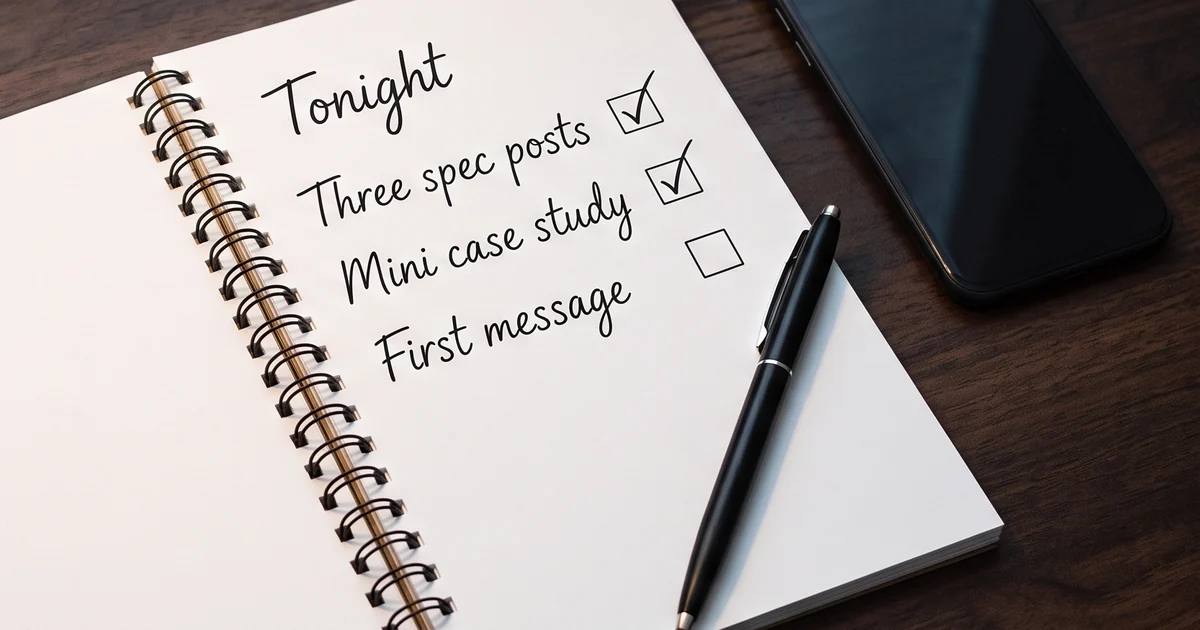
- The portfolio's only job is to earn you a conversation — the conversation is what closes the deal.
- The one-evening kit: three spec posts + one mini case-study + your own account, framed as proof you can grow one.
- Attach sample images directly in the first message; a cold Drive/Notion link lands in spam or a "Request Access" wall.
- Send to 10–20 businesses in one niche, not one — a single non-reply is a busy inbox, not a verdict.
Every guide says the same thing: no clients? Build a portfolio. So you sit down to build one, realize you have no client work to put in it, google "how do I build a portfolio with no clients," and land on a guide that says: build a portfolio. Beginners describe this exact loop, almost word for word. A thread posted on r/socialmedia on June 24, 2026, is literally titled "No portfolio. No clients. No experience. Can I still make money with social media marketing in 4 months?"
Here's the part no portfolio guide will admit, and it changes what you build: I got my first in-house social media job with no portfolio at all. Nobody asked for one. The interview was about the audience and what I would post first, not a deck. That is one real path, not evidence that portfolios never matter; practitioner accounts below show why the conversation and relevant examples often carry more weight than volume.
That doesn't mean skip the portfolio. Here's the difference: I already had an interview — a warm conversation, where they could hear me think. When you're reaching out cold, you don't have that yet, so the portfolio has exactly one honest job: to earn you that conversation in the first place. Which is great news, because a conversation-starter is small. You can build it tonight.
If the conversation decides, why build a portfolio at all?
Because with zero proof, the conversation never starts. A no-client portfolio isn't there to impress anyone. It's there to make you a safe person to reply to.
Before anyone replies to you, they're quietly answering three questions. None of them is "how many pieces are in the deck":
| What the buyer is really asking | What answers it |
|---|---|
| "Can this person do the work?" | 2–3 samples relevant to my business, not twenty generic ones — and you able to say exactly which parts you made |
| "Is it safe to hand them my brand's voice?" | Writing with no typos, a tone that matches the sample brand, sound judgment |
| "How much managing will this person cost me?" | A clear, short message; a simple process; you naming scope and next step yourself |
That first row has teeth, and buyers apply it harder than beginners expect. A small-business owner hiring a developer (not a social media manager, but the reflex is the same) described asking a candidate for one relevant example, then asking how much of it he had personally built: "when I asked if they worked on all aspects of that platform they admitted they only built the front page" (r/smallbusiness, November 2025). Show three pieces you can be questioned about, not twelve you'd have to defend.
Notice what's missing from all three rows: volume. Twelve case studies do not help if a buyer cannot connect them to a business result. A beginner on r/DigitalMarketing — 21 years old, 7,000 TikTok followers on an account he grew himself, plus certifications — wrote that he still could not land an interview. The most useful reply was to frame the account as evidence of deliberate growth rather than as a follower count. Same asset, clearer business meaning.
What do you actually build tonight?
Three things. Not ten. Each one answers one of the buyer's three questions above.
- Three unpaid sample posts (freelancers call this "spec work") for one real local business you'd like to work with. Pick one niche (cafés, gyms, dentists, something you can physically visit). Make three posts the way you would if they hired you: real captions, simple graphics built from the photos the business itself has posted publicly. (That's also why you can honestly tell them the samples are theirs, no strings: everything in the samples is built from photos they already own.) Label them honestly: "spec work: created as a sample, not commissioned." Honest labeling costs you nothing. Getting caught implying a client relationship that never existed can end your reputation before it starts.
- One mini case-study in goal → moves → result shape. No clients? Use the account you grew, even a small one. "Goal: grow a music account from 0. Moves: posting daily, hook-first captions, trend timing. Result: 7,000 followers in [X] months." The shape matters more than the size: it shows you think in outcomes, not posts.
- Your own account, framed as proof you know how to grow. Not "I have followers" — "here's what I did on purpose and what happened." That reframe is the difference between a hobby and a skill.
That's the whole kit: three spec posts, one case-study, one framed account. A basic one-platform client runs about 8–12 hours of work a month, at $300–800/month per client for beginners per Upwork's marketplace data — we broke down the real beginner rates earlier in this series. Your portfolio just needs to look like the trailer for that job.
What's the first message to send? (The part every guide skips)
Almost every portfolio guide ends with "then reach out!" — and somehow the message itself never gets written down. Here it is. Short, specific, no apology:
"Hi [name] — I made three sample posts showing what your Instagram could look like (attached). I work with [niche] and have room for one client this month. If you like the direction, I'd love 15 minutes to talk it through. Either way, the samples are yours, no strings."
Attach the images directly. Do not lead with a Google Drive or Notion link. A cold message whose whole point is a link often lands in spam or in the "message requests" folder nobody checks, and half the time the beginner forgot to set the link to "anyone with the link can view," so the owner hits a "Request Access" wall and gives up. Three images pasted straight into the email or DM dodge all of that. Keep the fancy Notion page for after they reply.
If you're in a DM where three images look clunky, use the two-step version: "Hi [name] — I made you 3 quick sample posts for your Instagram. Want me to send them over?" Almost nobody says no to that, and now you're in a conversation.
Why it works: the whole message is about their business. It gives before it asks, and the next step is tiny — 15 minutes, not "a partnership." "No strings" means there's nothing to be suspicious of.
If there's no reply in four business days, send one follow-up. Just one: "Hi [name], just floating this back up. If social's not a priority right now, no worries at all." Then move to the next business on your list. A single non-reply is usually a busy inbox, not a verdict on you — which is exactly why you send to 10–20, not one.
How much is enough — and how long until it pays?
Here's the math no guide prints. You don't need a bigger portfolio to start conversations; you need the kit above sent to 10–20 businesses in one niche. The working managers replying in that same r/socialmedia thread land on the same timeline, in their own words: "the thing actually stopping you isn't experience, it's proof, and proof is manufacturable fast… run social for 2–3 [local businesses] free or near-free for 60 days in exchange for real results and a testimonial. that's your portfolio." Another put it more bluntly: "In SMM, results are your portfolio, and you can build a killer case study in 60 days… stop studying and start doing."
So the realistic sequence is: one evening to build the kit, a few weeks of sending it, maybe one or two free-or-cheap test runs, and about 60 days to your first real, numbers-backed case study. Four months to a first paying client — the ask in that thread's title — is tight but possible on this path.
How does free work turn into paid work (instead of staying free forever)?
Free work is a tool, not a personality. It goes wrong in one specific way: nobody agreed, out loud, on when it ends and what happens next. So agree upfront, in the first conversation:
- A small price beats pure free. If you can, charge a token amount — even $50–100 for the 60 days — instead of nothing. A client who pays a little takes the work (and you) more seriously, and is far likelier to continue at full price than a pure freebie-seeker who vanishes the day you mention money.
- A fixed window: "I'll run your Instagram free (or near-free) for 60 days."
- A defined scope: the same 8-posts-a-month starter package you'd charge for, not unlimited everything. Draft the posts and let the owner approve and publish them at first, rather than asking for account passwords on day one.
- The exchange, named: "In return I get the results data and a short testimonial I can show."
- The after-price, named now: "If it's working after 60 days, we continue at $[your number]/month" — the same $300–800 beginner band from the rates piece. (Set your number with the free rate calculator, a one-minute, no-signup tool — don't invent it under pressure on day 59.)
Put those four lines in writing before you start — a plain message thread counts — and the free period is a test run with an exit. Skip them and you've volunteered indefinitely.
Frequently asked questions
Can I use big brands like Nike for spec work?
You can practice on anything, but for outreach, spec posts for a real local business you're actually messaging work far better — the owner sees their own shop, not a fantasy client. If you do use a known brand, label it clearly as unsolicited spec work, keep it in your portfolio only (don't publish it on public feeds), and never imply the brand hired you.
Is my personal account really a portfolio piece?
Yes — if you frame it as deliberate growth ("here's what I did and what happened"), not as a follower count. Buyers are paying for your ability to grow an account. The audience you already have is just the evidence.
How many pieces should the portfolio have?
Three spec posts and one mini case-study is enough to start conversations. Add real client results as they come; retire the spec work as soon as you can.
What if I freeze on the first message?
Send the exact script above to one low-stakes business, then write down what felt awkward. The second message has less uncertainty because you are editing a real attempt instead of imagining the perfect first one.
Do I need a portfolio website?
Not for your first clients. A clean Google Drive folder, Notion page, or PDF is fine. The message and the samples matter; the hosting doesn't.
Want the whole kit ready-made?
Get the free Portfolio Starter Kit by email — the one-evening checklist, a fill-in case-study template, and the first-message script (plus the follow-up) in one PDF. Every so often we send one more genuinely-useful thing for beginners. No spam, no course pitches.
Researches public data and practitioner accounts about social-media work, with a focus on client feedback, approvals and sign-off. More from Pauline P. →