Who else has to approve your client's posts?
 By Grig K.
- In our approval records the client-side decision took a median of 30 seconds, and 8 of 9 finished inside a minute.
- The delay lives in routing, not deliberation, so a faster reminder cadence does not fix it.
- Your day-to-day contact is often not the person with authority to approve.
- Ask for a name and a fallback name at kickoff, not a description of a process.
- Write the answer next to your deadlines, and re-ask it whenever your contact changes.
Why does approval take days when the decision takes seconds?
Every guide to client approval treats approving as a slow act of consideration. In our data it is not. The client-side approval page records how long the reviewer spends before tapping approve, and across the 9 approvals with that telemetry, the times were 10, 13, 14, 28, 30, 31, 34, 37, and 104 seconds. The median was 30 seconds and 8 of the 9 finished inside a minute.
The obvious objection is that they were not really looking. Our approval data says otherwise. The page will not enable the approve button until the whole post has been displayed, and that gate was satisfied in 9 of 9 records. Four of the posts were carousels, and in all 4 the reviewer swiped through every slide. Three reviewers played the video attached to the post. The median number of interactions before approving was 3, ranging from 0 to 21.
So this is not skimming. The reviewer opened the post, looked at all of it, and decided — in about half a minute. Four of the nine approvals came from a screen narrower than 500 pixels, which is to say a phone. The decision is made in a gap between other things, not in a review meeting.
Nine records is a small sample and belongs in the observation column, not the law column. But if the decision takes half a minute and your post waits nine days, almost all of that time was queueing: the post sat in an inbox belonging to someone who could not approve it, waiting to be forwarded to someone who could.
Who is the hidden approver?
Usually not the person you talk to. Industry guidance keeps landing on the same point: ZoomSphere argues that approval authority belongs to one named person on the client side, not to the marketing team as a group (ZoomSphere, who should approve social media posts). Agorapulse's process checklist opens the same way, asking agencies to identify which client-side roles sign off as one of the first things they map (Agorapulse, social media approval process).
What those guides describe from the outside, I saw from the inside. For years I ran companies where other people's work waited on my decision, and social media was the part I never once opened. Nothing was on fire there, so it never rose above the things that were. If someone had asked me directly whether I was slowing down the weekly posts, I'd have been genuinely surprised. I didn't know I was in the chain at all.
That is the uncomfortable shape of it. The hidden approver is often not withholding a yes. They do not know the queue exists, because the person in front of them absorbed it quietly for months. Set that next to the 30-second median above and the picture completes itself: nobody is deliberating for nine days. The post spent those days somewhere that was not a decision.
What exactly should you ask at kickoff?
Not "what is your approval process". That question invites a description of an ideal, and you will get one. Ask for people.
- Ask who has to see it before it goes live. Word it as a fact-finding question, not a challenge: "Besides you, does anyone need to see posts before they go live?" A named person is the answer you want. "It depends" is a warning.
- Ask for a fallback. "If you are away when something is time-sensitive, who can approve instead?" Holidays and illness are when a missing second name turns into a missed launch.
- Ask what the named person cares about. Legal wording, a regulated claim, a brand rule, a founder's personal preference. This tells you which posts will actually need routing and which will not.
- Write both names where your deadlines live. Not in a chat thread. Put it in the same document as your schedule, so the answer is visible on the day it matters.
Practitioners arrive at the same instinct from experience. In a discussion of endless approval loops on r/b2bmarketing, the suggestion that surfaced was to bring all stakeholders together early and agree themes up front, rather than discovering the extra reviewer one post at a time (r/b2bmarketing discussion on approval loops).
Who can block a post, and what to do about each?
| Who | How you find out too late | Ask at kickoff |
|---|---|---|
| Your day-to-day contact | They approve, then apologise a day later because someone above them disagreed | "Is your yes final, or does it go further?" |
| Their manager or the founder | A post sits for a week with no comment at all | "Besides you, who needs to see posts before they publish?" |
| Legal, compliance, or a regulated-claims reviewer | One specific post comes back rewritten beyond recognition | "Are there claims or topics that need a second pair of eyes?" |
| Nobody, officially | Silence, then a rushed yes at the deadline | "If you are away, who can approve instead?" |
The fourth row is the one beginners underestimate. An account with no named approver is not a fast account. It is an account where the decision has no owner, which is why it drifts to the deadline. Workweek's write-up on surviving social approvals makes the same point from the opposite direction, arguing that teams should agree in advance which posts genuinely need a sign-off at all rather than routing everything (Workweek, social media approvals without going insane). Both moves need the same missing piece: a name.
What if you already started and never asked?
Ask now, without framing it as a complaint. The honest version works: you are tightening the schedule and you want to know who to send things to when your contact is unavailable. That is a scheduling question, not an accusation, and it produces the same name.
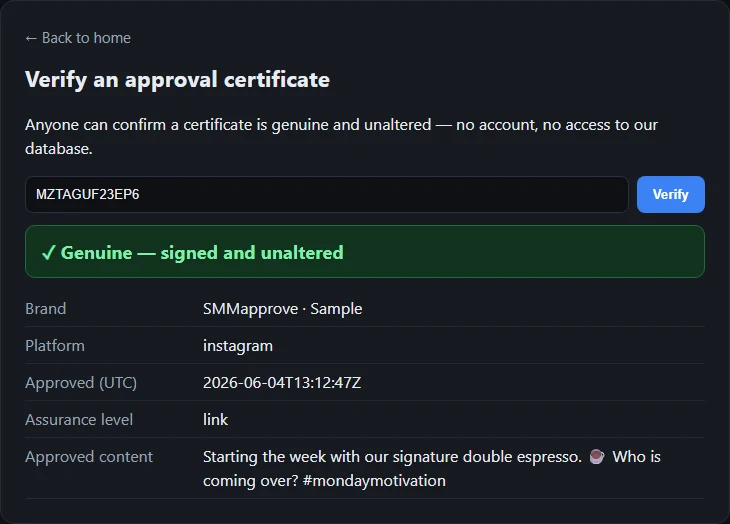
Then make the second name useful rather than decorative. Most published workflow guidance stops at defining steps and roles (DGTLsuite, building a social media approval workflow). The part worth adding is a plain record of who said yes and when, kept outside a chat thread, so a handover or a disagreement six weeks later does not depend on anyone's memory. If you want to see what written proof of client approval looks like, there's a public example you can open without an account: a tamper-evident record showing which post was approved and when, signed the moment the client tapped yes.
How do you keep the answer from going stale?
Re-ask it on three triggers: your contact changes job, the client launches something regulated or unusually public, or a post sits unanswered for longer than your normal turnaround. The third is the practical alarm. Given that 8 of our 9 recorded decisions took under a minute, a post sitting for 3 days is not a slow reader. It is a routing failure, and it is usually the first visible sign that the request quietly moved to someone new.
None of this replaces a clear process for getting the yes in the first place, which is a separate piece of the same problem — our guide to client approval and sign-off covers the mechanics of asking. The kickoff question sits before all of it. Every workflow you build assumes you know who it routes to.
Frequently asked questions
Is it rude to ask a client who else has to approve?
No, and it usually reads as professional. You are asking so that nothing waits on the wrong desk. Clients who've lived through a missed launch tend to answer immediately.
What if my contact insists they are the only approver?
Take the answer and write it down, then treat a single unexplained delay as a reason to ask again. People are often the final approver in principle and not in practice.
Will more reminders fix a slow approval?
Not on their own. If the post is queued with someone who cannot approve it, more reminders reach the same wrong inbox. Reminders help once the routing is right.
Should the second approver be named in the contract?
It does not need to be. Keeping the name beside your schedule, where you look on publishing day, is more useful than burying it in an agreement nobody reopens.
Writes about client approvals, sign-off and disputes in social-media work — the everyday spots where a 'yes' goes missing and someone gets blamed. More from Grig K. →